
HOA & Zoning Compliance for ADUs in Moreno Valley, CA
HOA and zoning compliance is the part of ADU Design & Permitting that stalls more projects in Moreno Valley than any other single issue – not because the rules are impossible, but because most homeowners don’t learn about them until a plan is already drawn and money has already changed hands. At Ellery ADU Studio, HOA review and City of Moreno Valley zoning analysis happen before a single line goes on paper, not after. If you’re weighing an ADU on your property and want to know what’s actually standing between you and a permitted structure, call us at (951) 379-3047 – a live person picks up, no voicemail queue.
This page covers what HOA and zoning compliance means specifically in Moreno Valley, what our process looks like, and what it costs – with written pricing before any work begins, per Haven Standard Clause 1. For the full picture of how compliance fits into our broader permit-through-construction process, see our ADU Design & Permitting in Moreno Valley page.
The short answer: in Moreno Valley, most single-family lots in HOA communities can accommodate an ADU under California state law (AB 2221 and SB 9 removed many HOA blanket prohibitions), but HOAs retain authority over exterior materials, color, and design consistency – and the City’s zoning code adds setback, height, and lot-coverage rules on top of that. Getting both layers right before construction starts is what keeps your project from being red-tagged or architecturally rejected six months in.
When You Need HOA & Zoning Compliance Review
- Your neighborhood has an HOA and you want to build a detached ADU or garage conversion. In communities like Morrison Ranch, Rancho Belago, and TownGate in Moreno Valley, HOAs cannot legally block an ADU outright under California law, but they can require that exterior finishes – siding, roofing, trim color – match the primary residence. Missing that requirement means a stop-work order after framing is already up.
- Your lot is smaller than 6,000 square feet. Moreno Valley’s R-1 zones have a 600-square-foot ADU minimum setback envelope that can shrink quickly on narrow lots. If your lot runs 50 feet wide or less, a zoning pre-check is the only way to know whether a standard 400- or 500-square-foot unit is actually buildable in the rear yard.
- You received an HOA denial letter or an architectural committee (ARC) rejection. ARC denials in Moreno Valley are often fixable – the issue is usually materials (the state law requires the HOA to accept any exterior material that matches the original structure, which opens the door for James Hardie fiber cement siding where the original home used it). We review the denial language, identify the specific objection, and revise the design to satisfy it.
- You’re considering a prefab or modular ADU. Units from brands like Abodu or Cover are factory-built and arrive on-site largely assembled. That’s efficient – but HOA architectural committees often flag them because the profile and finish options differ from site-built construction. We coordinate with the manufacturer’s design team to specify finishes that pass ARC review before the unit is ordered.
- Your property sits near a flood zone, slope, or arterial street in Moreno Valley. Alessandro Boulevard, Cactus Avenue, and Perris Boulevard corridors carry additional setback overlays in the City’s General Plan. If your parcel backs up to one of these or touches a FEMA Zone AE boundary (several parcels near the Box Springs area do), a zoning review catches the restriction before it kills a schematic you’ve already paid to develop.
- You want to build a Junior ADU (JADU) and aren’t sure whether your HOA CC&Rs allow interior conversion. Some older Moreno Valley HOA declarations predate the 2020 JADU law changes and contain language that appears to restrict interior conversions. California law overrides most of those clauses, but the documentation needs to be assembled correctly for the City’s plan checker and the HOA’s ARC simultaneously.
Our HOA & Zoning Compliance Process
-
CC&R and HOA Document Review
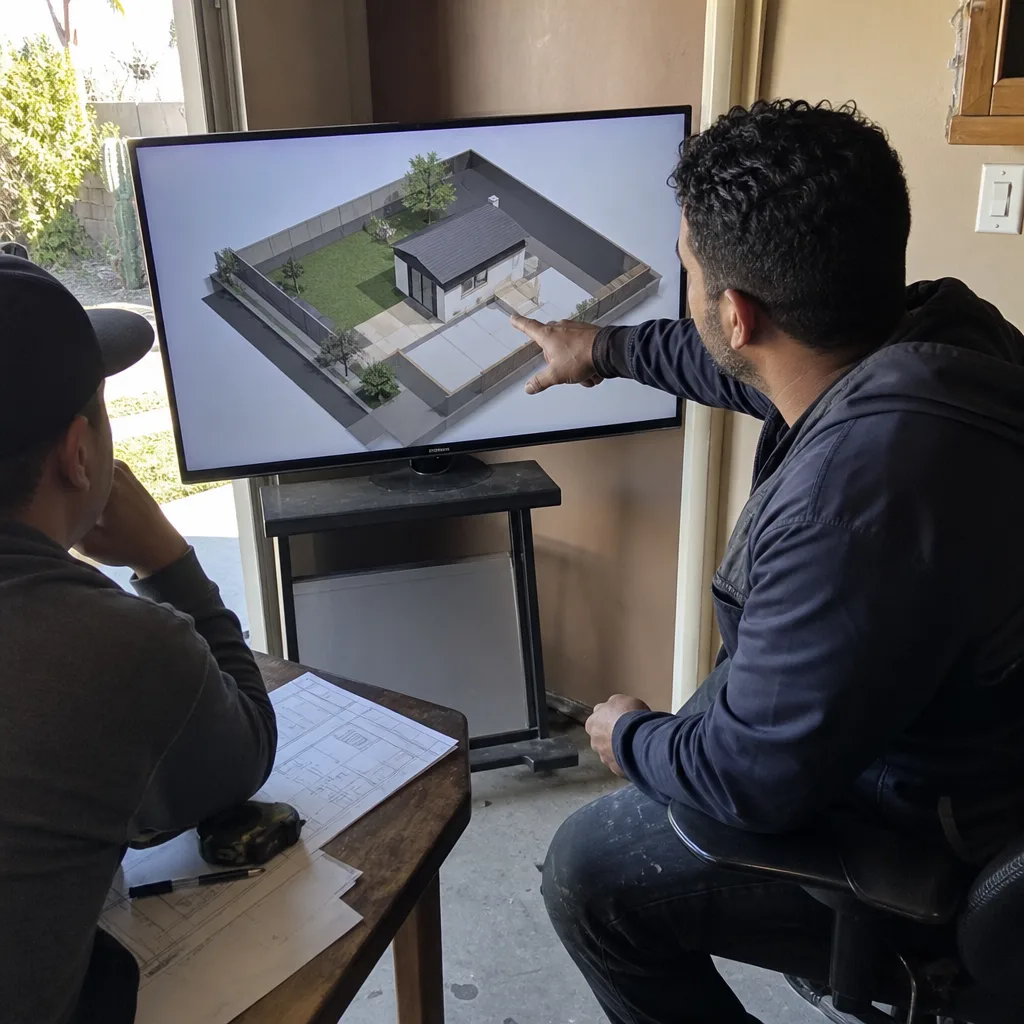
We start with your HOA’s Covenants, Conditions, and Restrictions – the actual recorded document, not the summary your HOA management company emails out. We read the architectural guidelines, the ARC submission requirements, and any amendments adopted after 2020 (when California law began overriding blanket ADU prohibitions). This takes roughly three to five business days and produces a written memo identifying every HOA design constraint that applies to your specific lot and proposed unit type. You get that memo before we draw anything.
-
City of Moreno Valley Zoning Analysis
Moreno Valley’s Development Code (Title 9) sets the baseline rules: setbacks (typically 4 feet rear and side for detached ADUs under 800 square feet), maximum unit height (16 feet for detached units in most R-1 zones), and lot coverage limits. We start with a Site Assessment of your parcel’s current zoning designation, check for any overlay districts (flood, fire, hillside), and confirm whether your lot qualifies for the streamlined ministerial review the City adopted under SB 13. The output is a one-page zoning summary showing what you can build, where it can sit, and what – if anything – requires a variance or administrative adjustment.
-
ARC Pre-Submission Package
Most HOA architectural committees in Moreno Valley require a site plan, elevations, materials board, and a color sample before they’ll schedule a Permit Application review meeting. We prepare that full package to the ARC’s stated submission format – usually a PDF set at a specific scale with manufacturer cut sheets attached. Getting this right the first time matters because ARC review cycles in Moreno Valley HOAs typically run 30 to 45 days; a rejected submission restarts the clock and delays your City permit application by the same amount.
-
ARC Submission and Response Management
We submit on your behalf, track the review status, and respond to any requests for additional information. If the ARC comes back with conditions – say, a specific paint color code or a requirement that the roofline pitch match the main house – we document the condition, incorporate it into the permitted drawing set, and confirm the revision in writing with the committee. Nothing gets changed without a paper trail, because the City’s plan checker will ask whether ARC approval was obtained, and the answer needs to be documented, not verbal.
-
City Permit Set Alignment
Once ARC approval is in hand, we reconcile the approved HOA design with the City’s permit set. This sounds mechanical, but it’s where errors most often occur in projects that use separate designers and builders: the ARC approves one set of dimensions and the City permit gets filed with another. Under Ellery’s one-contract design-build model, the same team that managed the ARC submission prepares the City permit drawings, so the two sets are identical by definition. That eliminates the designer-versus-builder documentation gap that derails projects elsewhere in the Inland Empire.
-
Final Compliance Documentation Package
At the close of compliance review, you receive: the ARC approval letter, the written zoning summary, the City-stamped permit set, and the documented photo record of any site conditions we noted during the analysis. Every item is indexed and saved in a project folder you can access at any time. Under the 365-Day Done Right Promise, if the finished ADU deviates from the permitted drawings in any material way, Ellery makes it right – in writing, before the project starts, not as a verbal assurance after the fact.
HOA & Zoning Compliance Pricing in Moreno Valley
HOA and zoning compliance work in Moreno Valley is scoped and priced in writing before any work begins – Haven Standard Clause 1 applies here exactly as it does to construction. There is no open-ended hourly rate that accumulates while we review your documents. Here are the typical ranges for standalone compliance work; when compliance is bundled into a full design-build contract, the cost is itemized as a line item in the same written quote.
| Scope | Typical Range | Notes |
|---|---|---|
| Zoning analysis only (no HOA) | $400 – $700 | Parcel research, overlay check, written summary |
| HOA CC&R review + written memo | $500 – $900 | Full CC&R read, not a summary; includes amendment review |
| ARC pre-submission package (drawings + materials board) | $1,200 – $2,400 | Depends on unit complexity and ARC format requirements |
| ARC submission management + response handling | $600 – $1,200 | Per submission cycle; resubmissions quoted separately if needed |
| Full compliance package (zoning + HOA + ARC) | $2,400 – $4,800 | Most common scope for Moreno Valley HOA communities |
| Compliance bundled into full design-build contract | Line item in written quote | No separate invoice; covered under one contract at one price |
What moves cost toward the higher end: HOA communities with older CC&Rs that require additional legal interpretation, lots with multiple overlay districts, ARC committees that meet infrequently (some Moreno Valley HOAs meet quarterly, which extends the timeline and the management hours), and projects involving prefab units like Abodu or Cover where the ARC is unfamiliar with the product line and requires manufacturer documentation.
What keeps cost toward the lower end: newer Moreno Valley HOAs with updated CC&Rs that already reference California ADU law, standard R-1 zoned lots with no overlay complications, and projects where the homeowner already has a recent survey and HOA document set ready to hand over.
Every project starts with a written price. Call (951) 379-3047 and we’ll tell you exactly what the compliance analysis for your specific parcel and HOA will cost before any work begins.
FAQs: HOA & Zoning Compliance for ADUs in Moreno Valley
Can my HOA in Moreno Valley legally block me from building an ADU?
No – California law (AB 2221, effective January 2023) prohibits HOAs from using CC&Rs to block ADU or JADU construction outright. Your HOA in Moreno Valley retains authority over exterior design consistency – materials, colors, and roofline character – but it cannot simply deny an ADU application on the basis that it doesn’t want additional units in the community. If you’ve received a flat denial from your HOA board, that denial likely isn’t enforceable as written, but the documentation to push back on it needs to be assembled correctly. Call us at (951) 379-3047 and we can review the denial language at no charge as part of a Free Second Opinion on any written documentation you already have.
How long does HOA ARC review take in Moreno Valley?
Most ARC committees in Moreno Valley HOA communities – including those governing the Rancho Belago and TownGate areas – operate on 30-to-45-day review cycles, and some meet only quarterly. That means a missed submission deadline can add three months to your project timeline before the City permit application even starts. Our ARC pre-submission package is specifically formatted to avoid rejection on procedural grounds (wrong scale, missing cut sheets, incomplete color specifications), which is the most common reason for a resubmission cycle. We track your ARC’s meeting schedule and submit with enough lead time to hit the next available review date.
What’s the difference between HOA compliance and City of Moreno Valley zoning approval?
They’re parallel requirements that don’t replace each other. The City of Moreno Valley reviews your ADU against its Development Code – setbacks, height, lot coverage, fire access, and utility connections. The HOA reviews the same project against its CC&Rs and architectural guidelines, which govern appearance rather than land use. You need both approvals, and they run on different timelines with different documentation. The City can issue a permit even if your ARC review is still pending, but construction that begins before ARC approval can trigger HOA enforcement action – fines, stop-work letters, and in some cases a requirement to alter the completed structure. Getting both approvals before breaking ground is the only safe path.
Does Moreno Valley have any local zoning rules that specifically affect ADU setbacks or height?
Yes, and a few are worth knowing before you sketch anything. For detached ADUs under 800 square feet on R-1 zoned lots, Moreno Valley applies a 4-foot rear and side setback under the state-mandated streamlined review process – which is more permissive than the standard 5-foot setback the City applied before SB 13 – and we verify Title 24 Energy Compliance requirements as part of the full permit package. However, corner lots and lots that back up to arterial streets (Alessandro Boulevard and Cactus Avenue are the most common cases we see in Moreno Valley) may carry additional setback overlays from the City’s General Plan that push the effective setback further back than 4 feet. Height limits for detached ADUs in R-1 zones generally cap at 16 feet, though a two-story ADU above a garage can go to 25 feet under specific conditions. We see the Perris Boulevard corridor come up frequently – parcels there often have commercial adjacency overlays that affect what’s permissible. A written zoning summary for your specific parcel is the only way to know for certain which rules apply.
Why This Work Fits Inside a Single Contract
Homeowners who hire a separate designer for compliance and a separate contractor for construction regularly hit the same problem: when the ARC-approved drawings and the City permit drawings don’t match, both parties point at the other. The designer says the contractor deviated from the approved set; the contractor says the designer’s drawings were incomplete. Meanwhile, the homeowner is sitting on a red-tagged project with no clear path forward.
Ellery’s one-contract design-build model closes that gap because the same team that managed your ARC submission also draws the permit set and supervises the build. The drawings are the same document throughout. If something changes – an ARC condition, a City plan-check comment, a field condition during construction – the revision is made in writing and reflected across the full permit set before work continues. That’s not a policy we invented to differentiate ourselves; it’s just what responsible design-build practice looks like, and it’s documented in your contract before anything starts.
This is also why we specify prefab products within the same single contract rather than handing you a spec sheet and wishing you luck. When a Moreno Valley HOA’s ARC needs manufacturer documentation for a prefab unit, we get it from the manufacturer directly, format it to the ARC’s submission requirements, and include it in the pre-submission package. The homeowner doesn’t end up in the middle of a phone call between an ARC volunteer and a factory customer service line.
Since 2015, Ellery has navigated HOA and zoning compliance for ADU projects across the Inland Empire – including the specific HOA communities, plan-check workflows, and ARC temperaments that are particular to Moreno Valley. That experience is what our home page summarizes; this page is where it gets applied to your specific layer of the problem.
Key Takeaways
- California law prevents Moreno Valley HOAs from blocking ADUs outright, but HOAs retain authority over exterior design – and that authority is real and enforceable.
- HOA ARC review and City zoning approval run on separate timelines and require separate documentation sets; missing either one delays construction.
- Corner lots, arterial-adjacent parcels, and FEMA Zone AE properties in Moreno Valley carry overlay restrictions that a standard R-1 setback analysis won’t catch.
- ARC review cycles in most Moreno Valley HOA communities run 30-45 days; a rejected submission restarts that clock.
- Every compliance scope at Ellery is quoted in writing before work starts, per Haven Standard Clause 1 – no open-ended hourly accumulation.
- The 365-Day Done Right Promise applies: if the finished ADU deviates from the permitted drawings, Ellery makes it right, documented in your contract before work begins.
Start with a Written Price, Not a Conversation That Goes Nowhere
If you’re in Moreno Valley and you’re trying to figure out whether your HOA or the City’s zoning code is the bigger obstacle to your ADU project – or both – call (951) 379-3047. A live person answers. We’ll ask about your parcel, your HOA, and what you’re trying to build, and we’ll give you a written price for the compliance analysis before any work begins. That’s what Haven Clause 1 says, and that’s what we do on every project.
If you already have a written estimate from another firm and want a second set of eyes on it, the Free Second Opinion is available at no charge – bring the document, and we’ll tell you what it covers and what it doesn’t.
Written by Nadia Ellery, Owner at Ellery ADU Studio Moreno Valley, serving Moreno Valley.